It is a standard practice in most pagan rituals, even though there are some who foolishly claim it to be irrelevant or no longer necessary. Contrary to what some say, casting a circle of protection is not a Wiccan invention, and is not a product of modern paganism. Although the methods of casting the circle have changed over time, the practice itself is many centuries old. The earliest mention of casting a magic circle dates back to ancient Mesopotamia. The Sumerians referred to this practice as Zisurrû, where circles were created as sacred spaces for offerings to ancestors, deities, and spirits. This ritual evolved over time, with formal structures emerging in the context of Solomonic magic during the medieval period, where circles were inscribed with divine names and protective symbols. Zisurrû, meaning “magic circle drawn with flour”, was a means of delineating, purifying and protecting from harm by enclosing a ritual space in a circle of flour. It also involved ritual drawings to counter different threats. This practice is documented in various historical sources, including cuneiform tablets and scholarly interpretations of Mesopotamian rituals. The earliest mythological reference to casting the magic circle can be traced back to ancient Greece. The concept of the Temenos, a sacred boundary, was established as a space cut off from the ordinary world and dedicated to deities.
During the medieval period, the magic circle became prominent in grimoires and magical texts, where it was often used in ceremonial magic to summon and control spirits. In today’s practices, the magic circle is still utilized for protection and to create a sacred space during rituals. The magic circle symbolizes the connection between the physical and spiritual realms, emphasizing the importance of intention and focus in magical practices. Overall, the magic circle has evolved from ancient protective rituals to a modern tool for spiritual and magical work, maintaining its significance across cultures and time periods. The magic circle is depicted in several medieval woodcuts, and in artwork such as “The Magic Circle” by John William Waterhouse (pictured below), created in 1886. This oil painting showcases a witch or sorceress drawing a fiery magic circle on the ground, symbolizing a ritual space. In this particular piece, she is using a sword to cast the circle.
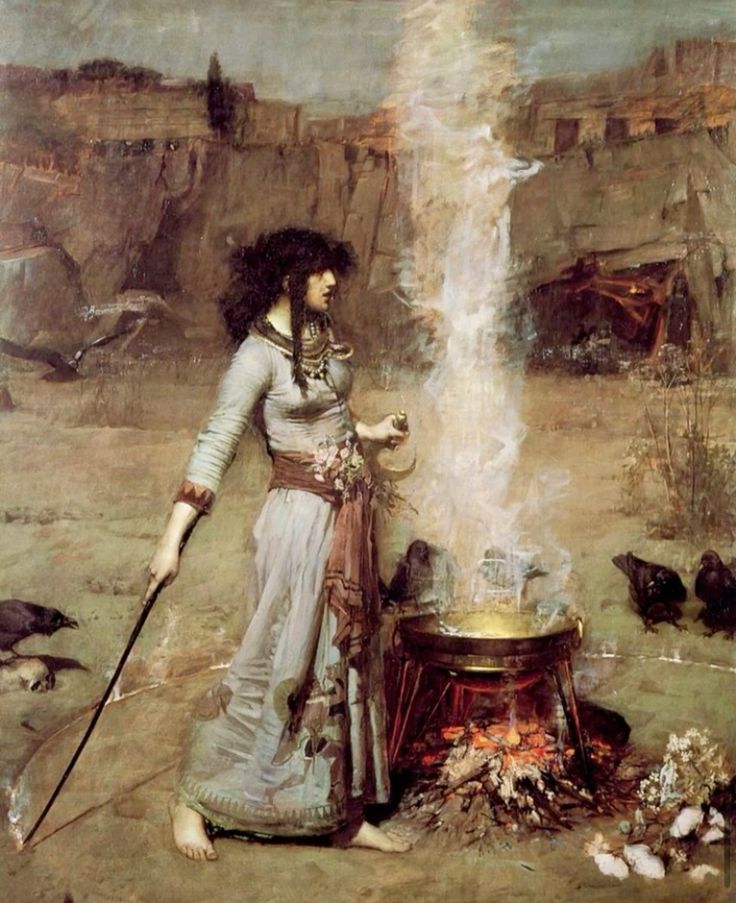
Some of today’s witchcraft traditions do use a sword to cast the circle, others use a wand, while still others will draw the circle using only their fingers. In some Old Ways practices, the circle is cast by scattering a blend of carefully selected herbs and salt around the perimeter. Some traditions will point to the ground while casting the circle, while others will “draw” the circle in the air. This is combined with incantation and visualization, which forms an energy field around, above and below the circle to form a sphere.
The purposes of the magic circle include:
*To protect those in the circle from harmful energy.
*To allow in only the energies that are called forth.
*To be a sacred space and ‘world between worlds’.
*To contain the energy raised and keep it pure from outside contamination.
Generally, the circle is cast while walking three times in a clockwise direction, and released or dispersed while moving only once counter-clockwise. A typical circle casting incantation might sound like this:
“I CAST THIS CIRCLE TO PROTECT ME FROM ALL HARMFUL ENERGIES. I CAST THIS CIRCLE TO ALLOW ONLY THE HIGHEST GOOD, AND BLOCK OUT ALL OTHER ENERGIES. I CAST THIS CIRCLE TO BE A SACRED SPACE AND A WORLD BETWEEN WORLDS”.
Actual methods will vary according to tradition or specific practice. In my own practice today, I use a wand, however, I was taught using a sword. If using a wand, it’s best to use one made from natural materials rather than those made of resin. Novelty wands can be fun, but they do not carry or direct energy well.
Casting the magic circle has always been a relevant practice, and those who choose to forego it usually find their magic to be less effective. It brings with it the energy of many centuries of practitioners who also called it forth for protection and ritual.

