Magical Origins: Casting The Circle

It is a standard practice in most pagan rituals, even though there are some who foolishly claim it to be irrelevant or no longer necessary. Contrary to what some say, casting a circle of protection is not a Wiccan invention, and is not a product of modern paganism. Although the methods of casting the circle have changed over time, the practice itself is many centuries old. The earliest mention of casting a magic circle dates back to ancient Mesopotamia. The Sumerians referred to this practice as Zisurrû, where circles were created as sacred spaces for offerings to ancestors, deities, and spirits. This ritual evolved over time, with formal structures emerging in the context of Solomonic magic during the medieval period, where circles were inscribed with divine names and protective symbols. Zisurrû, meaning “magic circle drawn with flour”, was a means of delineating, purifying and protecting from harm by enclosing a ritual space in a circle of flour. It also involved ritual drawings to counter different threats. This practice is documented in various historical sources, including cuneiform tablets and scholarly interpretations of Mesopotamian rituals. The earliest mythological reference to casting the magic circle can be traced back to ancient Greece. The concept of the Temenos, a sacred boundary, was established as a space cut off from the ordinary world and dedicated to deities.

During the medieval period, the magic circle became prominent in grimoires and magical texts, where it was often used in ceremonial magic to summon and control spirits. In today’s practices, the magic circle is still utilized for protection and to create a sacred space during rituals. The magic circle symbolizes the connection between the physical and spiritual realms, emphasizing the importance of intention and focus in magical practices. Overall, the magic circle has evolved from ancient protective rituals to a modern tool for spiritual and magical work, maintaining its significance across cultures and time periods. The magic circle is depicted in several medieval woodcuts, and in artwork such as “The Magic Circle” by John William Waterhouse (pictured below), created in 1886. This oil painting showcases a witch or sorceress drawing a fiery magic circle on the ground, symbolizing a ritual space. In this particular piece, she is using a sword to cast the circle.
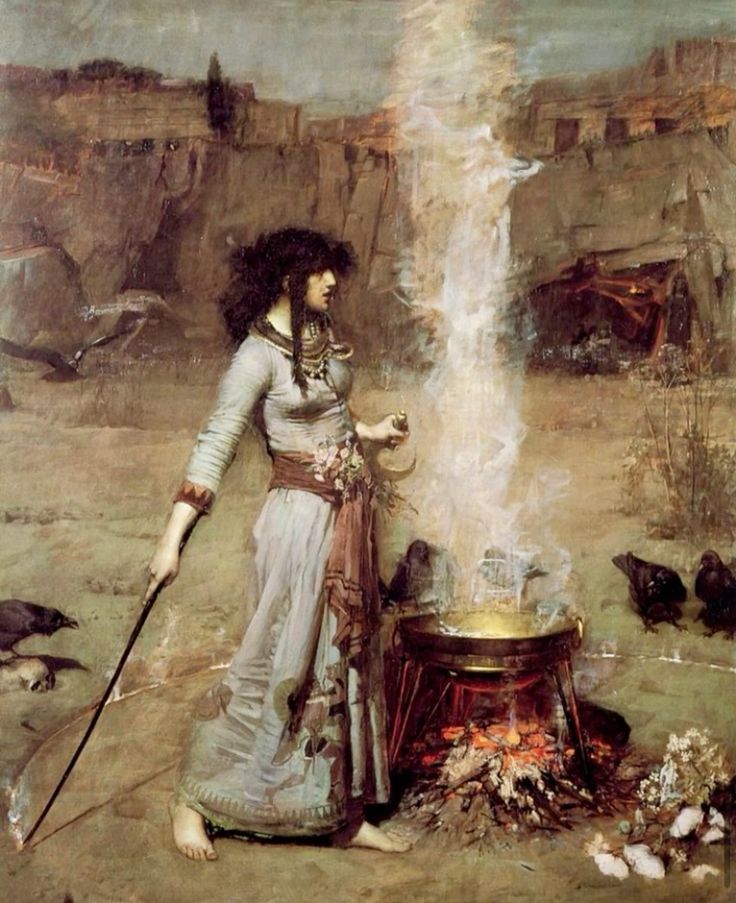
Some of today’s witchcraft traditions do use a sword to cast the circle, others use a wand, while still others will draw the circle using only their fingers. In some Old Ways practices, the circle is cast by scattering a blend of carefully selected herbs and salt around the perimeter. Some traditions will point to the ground while casting the circle, while others will “draw” the circle in the air. This is combined with incantation and visualization, which forms an energy field around, above and below the circle to form a sphere.

The purposes of the magic circle include:

*To protect those in the circle from harmful energy.

*To allow in only the energies that are called forth.

*To be a sacred space and ‘world between worlds’.

*To contain the energy raised and keep it pure from outside contamination.

Generally, the circle is cast while walking three times in a clockwise direction, and released or dispersed while moving only once counter-clockwise. A typical circle casting incantation might sound like this:

“I CAST THIS CIRCLE TO PROTECT ME FROM ALL HARMFUL ENERGIES. I CAST THIS CIRCLE TO ALLOW ONLY THE HIGHEST GOOD, AND BLOCK OUT ALL OTHER ENERGIES. I CAST THIS CIRCLE TO BE A SACRED SPACE AND A WORLD BETWEEN WORLDS”.

Actual methods will vary according to tradition or specific practice. In my own practice today, I use a wand, however, I was taught using a sword. If using a wand, it’s best to use one made from natural materials rather than those made of resin. Novelty wands can be fun, but they do not carry or direct energy well.

Casting the magic circle has always been a relevant practice, and those who choose to forego it usually find their magic to be less effective. It brings with it the energy of many centuries of practitioners who also called it forth for protection and ritual.
Call To The Nameless Ones

He Who Dwells In The Forest, and walks among the trees,

Whose presence is felt in the deep woods, and in the rustling of the leaves,

Bud, flower, stem and leaf are at your beck and call,

Hoof and horn, feather and wing, you rule over them all.

She Who Inhabits The Moon, and illuminates the night,

Whose magic is reflected upon the earth by the power of lunar light,

Hidden wisdom you reveal to those with ears to hear,

Waning dark and waxing full on those who would draw near.

Be with us now, O Nameless Ones,

And keep us in your sight,

Teach us your ways and keep us close,

In forest and moonlight.

Origins: Magical Grimoires

While the expression “Book of Shadows” is a modern Wiccan invention (coined by Gerald Gardner in 1949), the actual practice of documenting spells and enchantments is quite ancient. The term ‘grimoire’ (meaning a book of magic and witchcraft) is believed to have originated from a mispronunciation of the word “grammar,” reflecting a time when literacy was limited and any book might be thought to contain magical knowledge. The oldest known grimoires date back to ancient Mesopotamia and Egypt. The earliest magical incantations were inscribed on cuneiform clay tablets from the city of Uruk, dating to between the 5th and 4th centuries BC. These texts include spells and rituals that influenced later magical traditions. In ancient Egypt, the magical system known as Heka was integral to religion and culture. Elaborate magical workings were documented on temple walls, papyrus scrolls, and sacred amulets. The Egyptian magical texts include spells that were used for various purposes, such as healing and protection. Another significant collection is the Greek Magical Papyri. These ancient texts, primarily written in Greek, and dating from the 4th to 2nd centuries CE, contain a variety of magical spells, rituals and hymns. Numerous translations exist today, including modern readable versions that provide context and explanations. These texts not only provide insight into ancient magical practices but also influenced later systems like those of the Golden Dawn and Wicca. Among the oldest surviving medieval grimoires is the “Sworn Book of Honorius,” attributed to Honorius of Thebes, which has influenced many later works.

When we look to mythology, the first mention of a book of spells is often attributed to the ancient Egyptian “Book of Thoth.“ This book appears in stories from the Ptolemaic period and is said to contain powerful spells, including one that allows the reader to understand the speech of animals and another that enables the perception of gods. The book itself is a legendary text in Egyptian mythology, attributed to the god Thoth, and is said to be cursed, bringing destruction to those who attempt to steal it.

Just as in the grimoires kept by witches of today, ancient magical writings reflect a belief in the ability to influence supernatural forces to achieve desired outcomes. This includes invoking deities or spirits for protection, healing, or control over various aspects of life, such as love and fortune. Many texts detail specific rituals and incantations designed to harness magical powers. These practices served as guides for practitioners to navigate the complexities of the magical world and interact with the divine. A significant theme is the use of symbols and spells intended to ward off evil or misfortune. This reflects a cultural emphasis on protection against malevolent forces. Healing practices are prevalent, with texts often describing methods to cure illnesses believed to be caused by supernatural entities. This highlights the intersection of magic and medicine in ancient societies. The Key of Solomon and the Three Books of Occult Philosophy are two other magical grimoires that some may be familiar with, and these also are quite old.

We see from these historical and mythological references that keeping magical grimoires, and the documenting of spells and rituals is not a modern concept. We may call these books by modern names, but the magic contained within them is rooted in ancient practices.

Return of the Autumn Equinox

Equinoxes are key astronomical events that mark the changing of seasons. They occur twice a year, specifically during the Spring Equinox in March and the Autumn Equinox in September. During these times, the earth’s axis is tilted neither toward nor away from the sun, resulting in nearly equal amounts of daylight and darkness across the globe. The observance of the autumn equinox has ancient roots, dating back thousands of years. It has been celebrated in various cultures worldwide, often marking the time for harvest and community gatherings. The specific traditions and significance can vary, but the event itself has been recognized since ancient agricultural societies, making it a significant astronomical and cultural milestone.

Many modern pagans and Wiccans refer to this holiday as Mabon, associating it with the Welsh figure of the same name. However, this is a modern association which started in the 1970’s by American Wiccan Aidan Kelley. In truth, the Mabon figure has no historical or mythological ties to the Autumn Equinox whatsoever. There are a few elements in the story of Mabon that can be loosely connected to the equinox, but these are purely speculative. Mabon’s story can be found in The Mabinogion, a collection ancient Welsh tales. There are a few different translations, of which I own three. I no longer refer to the holiday as Mabon, but simply as the Autumn Equinox.

The celebration of the Autumn Equinox has ancient roots, dating back thousands of years. It has been observed in various cultures worldwide, often coinciding with harvest festivals. The specific traditions and significance can vary, but the equinox itself has been recognized for at least 2,000 years, with some evidence suggesting even earlier practices related to agricultural cycles. At this time, the hours of day and night are of equal length. A popular theme for the holiday is ‘balance’, but after today the nights will begin to grow longer and we enter a period of darkness. It is a time to be grateful for our personal harvests, but it is also a time for looking within. It is a time for letting go of things that are no longer working. It is a time of preparing for what lies ahead. This seasonal change is a reminder that the cold and long dark nights will once again return, and we must be ready.

The Old Ways Are Still Alive

The ominous presence in the deep forest…tree leaves rustling in the wind…the dance of a candle flame…the sounds of a soft flowing stream…these are all subtle cues from nature that gently lead us to the Old Ways. Some will listen and take heed, while most others won’t even notice.

The old ways of witchcraft are rooted in nature and the elements. They can be glimpsed in the moon, the stars and planets. They can be hidden in symbols and images. They can be interpreted in cards and bits of wood and stone. The old ways are found only by those with the ability to see and tap into them. These magical folk are the Witches of the Old Ways.

Some modern witches scoff at the term ‘old ways’ as if the practice of witchcraft is somehow a modern invention. The ways are indeed old, and hearken back to days of the Wise Women and Cunning Men. The Old Ways pre-date Wicca or any other “modern” interpretations of witchcraft. Witches of ages past were sovereign, not bound by imposed ‘redes’ or ‘threefold’ laws. Witches were simply witches, living by their own ethical codes and personal standards. They did not live and move among the people, but dwelled on the outskirts of villages and towns, offering their services in secret. This is the true path of the Old Ways Witch, with the power to both cure and curse. To provoke an Old Ways witch was to bring misfortune on oneself, and they did not turn the other cheek. Old Ways Witchcraft is not always a path of love and light, but also of darkness and reckoning.

Nature is viewed as alive and sentient. Plants and stones are believed to contain a living, indwelling spirit. We ourselves are considered to be divine aspects of nature, working alongside the forces of the universe to bring change. In recent times, witchcraft has become somewhat Disney-fied to make it more palatable to outsiders, but it was never meant to be so. Witches of the Old Ways are respected and feared in equal measure. We are not docile and harmless. We embrace our sovereignty. We embrace our power. We embrace our connection to nature, and we respect those who respect us.

Will you walk with us along the path?